
If you’ve ever been stuck in a “departure board domino effect” at Chicago O’Hare (ORD), you already understand the core issue: when the published schedule is bigger than what the airport and air traffic system can realistically handle, delays compound—fast.
To reduce the risk of widespread delays and cancellations during peak summer travel, the FAA issued an order establishing temporary scheduling limits at ORD. The goal is straightforward: align the daily flight schedule with what the airport can safely and efficiently process—especially with ongoing construction and surface constraints.
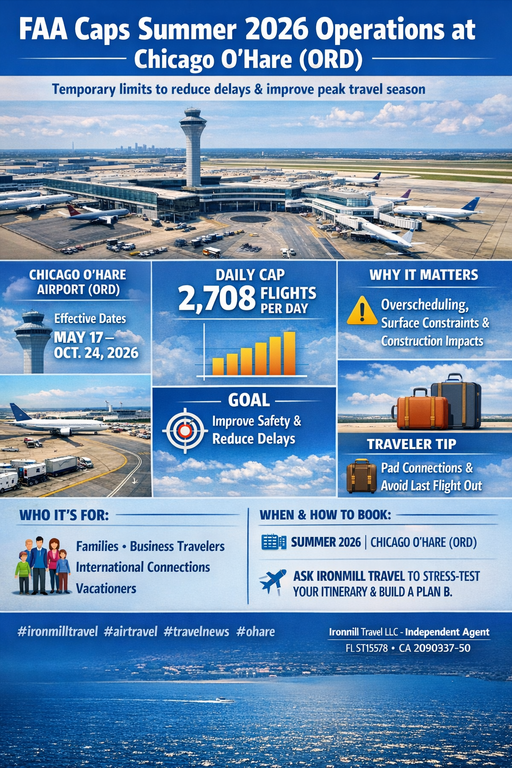
A temporary FAA scheduling reduction aims to reduce cascading delays at one of America’s busiest hubs.
Quick Facts for Travelers (Save This)
- What it is: A temporary FAA “scheduling reduction” that caps daily operations at Chicago O’Hare (ORD) to reduce congestion-driven delays.
- Who it’s best for: Anyone flying through ORD between late spring and fall 2026—especially travelers with tight connections, families, groups, and business travelers.
- Where: Chicago O’Hare International Airport (ORD), Chicago, Illinois.
- When: May 17 to October 24, 2026 (daily operating limits during the schedule-facilitated day).
- Trip length / format: Not trip-specific—this is an airport operations policy that can impact many itineraries.
- Key highlights: Cap set at 2,708 operations/day; published peak schedules were noted as exceeding 3,080 daily operations; limits are allocated proportionally based on Summer 2025 approved schedules.
- Why it matters: Fewer “unrealistic” scheduled operations can reduce cascading delays and improve reliability across the day (and across the broader airspace system).
- Planning tip: Treat ORD like a “buffer airport” this summer—pad connections, avoid last flight of the night, and keep flexibility where possible.
- How to book: Have Ironmill Travel pressure-test your routing (connection times, alternates, seat strategy, disruption resilience) before you ticket.
What’s changing at O’Hare (in plain English)
The FAA’s order sets a temporary daily cap on arrivals + departures at O’Hare: 2,708 total operations per day, with allocations distributed across airlines based on their approved Summer 2025 schedules.
Why this matters: airlines can publish aggressive schedules, but when runway/terminal/taxiway constraints (and staffing realities) collide with peak demand, the result is predictable—delays, missed connections, crew timeouts, and cancellations that ripple through the system.
The FAA’s order describes the purpose as improving safety and efficiency, reducing surface movement in constrained taxiway environments, and mitigating major traveler inconvenience from excessive delays.
Why the FAA stepped in now
Two numbers tell the story:
- The FAA noted that published schedules exceed 3,080 daily operations on peak days for Summer 2026—described as a 14.9% increase over a Summer 2025 peak day.
- In Summer 2025 performance at ORD, the order cites on-time performance context and highlights that only 56% of departures and 58% of arrivals experienced no delay (as defined in the order’s performance discussion).
Layer in continued construction/surface constraints, and the FAA’s position is essentially: without a cap, the airport risks being overscheduled beyond what it can handle.
The official window and what it means for your itinerary
The limits apply May 17 through October 24, 2026, with the FAA describing daily constraints across the schedule-facilitated day (including half-hourly pacing to allow operational recovery).
What you may see as a traveler:
- A schedule change (time shift) before you travel
- A canceled flight paired with a re-accommodation option
- Longer connection times becoming the “safer” choice
- Some routes shifting to different times of day to fit within the cap
This isn’t a guarantee of perfect operations—but it is a structural attempt to reduce the “too many flights at once” problem that fuels system-wide disruption.
What the DOT and FAA leaders said
“If you book a ticket, we want you and your family to have the certainty that you’ll fly without endless delays and cancellations,” said U.S. Transportation Secretary Sean P. Duffy. “We successfully turned Newark Liberty International into the most on-time airport in the Tri-State Area by fixing telecoms issues at record speed and reducing overcapacity. Applying that same strategy at O’Hare – where unrealistic schedules were set to dramatically exceed what they could handle – will reduce delays and make this busy summer travel season a little easier. Along with our work to modernize air traffic control and boost staffing, the Trump Administration is using every tool at its disposal to deliver a safe, efficient, and seamless flying experience.”
“Our number one priority is the safety of the flying public, and that means ensuring airline schedules reflect what the system can safely handle,” said FAA Administrator Bryan Bedford. “We appreciate the airlines working together with us to reach a responsible level of operations that strengthens safety and delivers a more reliable travel experience for the American public.”
Ironmill Travel’s “smart routing” playbook for ORD this summer
Here’s what I’m advising for clients transiting or originating at Chicago O’Hare (ORD) during the capped period:
1) Build in connection slack (especially for international)
If your current connection time feels “tight but doable,” treat it as tight—period. Choose a routing with a real buffer.
2) Avoid the last flight out when possible
When the day runs late, rebooking options shrink. Earlier flights give you more runway (pun intended) if something goes sideways.
3) Keep itineraries disruption-resilient
Whenever you can: nonstop > one-stop > two-stops. Fewer moving pieces, fewer failure points.
4) Know your Plan B before you need it
Alternate airports, later flights, or a same-day rail option (where relevant). We map this before you travel—not while you’re standing at the gate.
If you want, send me your ORD itinerary (dates + flight numbers), and I’ll sanity-check connection risk and backup paths.
#ironmilltravel #airtravel #travelnews #chicago
Ironmill Travel LLC – Independent Agent (FST ST15578 | CST 2090937-50)